

🖨️
On August 5, China’s Ministry of Commerce (MOFCOM) launched an investigation into imported printing and copying equipment equipped with foreign system software. Marked as Announcement No. 33, this move represents China’s first-ever “national security investigation” under foreign trade regulations. But why has a humble office printer suddenly found itself at the center of geopolitical tensions? Here is the breakdown:
“Tit-for-Tat” Retaliation
This countermeasure didn’t come out of nowhere. It is a direct response to escalating U.S. restrictions. On July 31, the U.S. Department of Homeland Security added over 40 Chinese entities to its so-called “Uyghur Forced Labor Prevention Act Entity List.” Prior to that, the FCC had successively imposed limits on Chinese telecom operators, testing labs, drones, consumer routers, undersea cables, advanced robotics, and power inverters.
In the realm of international trade, this is a textbook example of a tit-for-tat strategy: when one side ramps up restrictions, the other responds in kind. In repeated games, failing to respond is often interpreted as a signal of weakness.
China's countermeasures include strengthening export controls on dual-use items related to UAVs and their key components and technologies to the US; suspending factory follow-up inspections entrusted to US certification bodies by China Compulsory Certification designated bodies; placing US compliance testing companies on the countermeasure list; initiating a national security investigation into the import of printing and copying office equipment; and placing six US entities on the countermeasure list.
However, MOFCOM spokespersons emphasized that this countermeasure is “generally restrained,” reflecting the rational boundaries of “cooperation–punishment–return to cooperation” in game theory.
"If the US insists on introducing new restrictive measures against China, China will take further countermeasures," the spokesperson stated.
Why Printers? The “National Security Exception”
Why target printers instead of other goods? China Tech Bite supposes that they uniquely satisfy two critical conditions: high relevance to daily life and high security sensitivity. Printing and copying devices are ubiquitous in offices, classrooms, and government document centers. Crucially, their “foreign system software” (including drivers and embedded firmware) possesses technical channels for data transmission and remote control, posing risks of back doors and information leakage.
The investigation is grounded in Article 41 of China’s Foreign Trade Law, which corresponds to the national security exception (GATT Article 21) under WTO rules. This provision serves as a legal window for countries to safeguard security, and this marks the first time China has activated this specific tool.
Data Deep Dive: Import Scale from 2021 to H1 2026
Start by looking at the import volume and overall trends. The table below presents import data for “printers, copiers, and multi-function devices” (HS codes 84431–84433), based on figures from the General Administration of Customs of China:
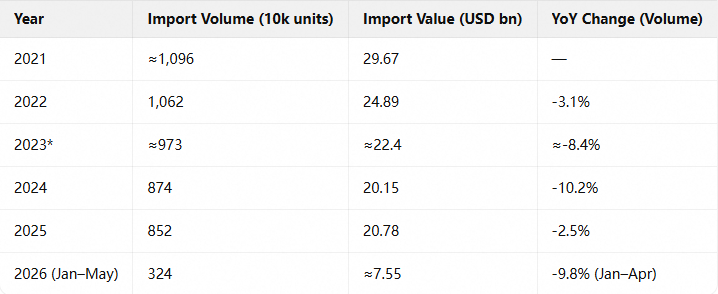
Source: General Administration of Customs of China. The 2023 figures are estimates extrapolated from monthly data, while the 2026 data represents the cumulative total from January to May (as complete June data has not yet been released).
The data reveals a market that is already shrinking. Over the past five years, import volume dropped from approximately 10.96 million units to 8.52 million—a decline of about 22%. Meanwhile, the import value fell from $2.967 billion to $2.078 billion, representing a steeper drop of roughly 30%.
The Foundation for Countermeasures: A Verifiable Logic Chain
Market Share Reversal: According to IDC data, the market share of domestic A4 laser printers in China surged from 16% in 2010 to 42% in 2024, with cumulative shipments exceeding 40 million units.
Core Technological Breakthroughs: Pantum (a subsidiary of Ninestar) launched its first fully independent A3 copier in 2024, breaking through a barrier of approximately 200,000 patents. It now commands over 40% of the government and enterprise market.
Trade Surplus as a Buffer: In 2025, China exported 45.71 million units while importing 8.52 million. With exports more than five times the volume of imports, the cost of imposing tariffs or import restrictions remains highly manageable.
Mastering the Learning Curve: Over the past 30 years, domestic brands have achieved a 24% compound annual growth rate (CAGR), with economies of scale firmly past the break-even point.
Substitution Outlook: US Brands vs. Domestic and Japanese Alternatives
While the investigation formally targets “foreign system software,” the immediate real-world impact will likely manifest as a shift in brand dynamics. Below are the key US-origin brands currently involved in the Chinese market:
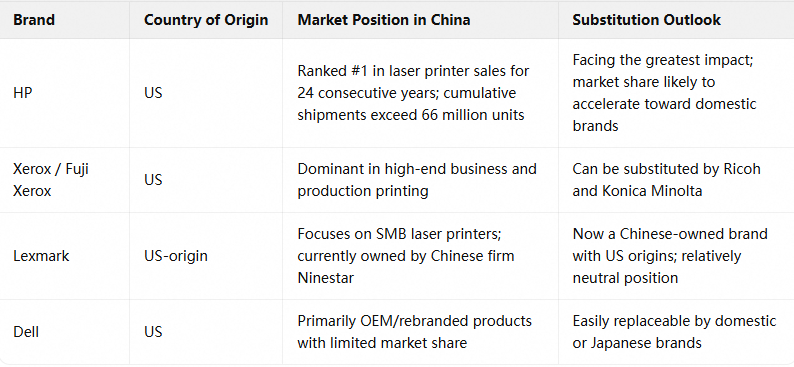
Japanese Alternatives: Canon, Kyocera, Ricoh, Brother, Konica Minolta, Epson.
Note: Given the current tensions in Sino-Japanese relations, Japanese equipment is not entirely immune and could potentially face similar countermeasures in the future.