
The FCC Didn't Catch Everything: Why China’s Drone Export Control Still Matters
While the FCC blocks new drone models, China's latest export controls strategically target the critical high-performance components and technologies the U.S. still needs.

On August 5, China’s Ministry of Commerce (MOFCOM) issued Announcement No. 34 of 2026, deciding to implement case-by-case strict review for the export of drones, key components, and related technologies listed in the “Export Control List of Dual-Use Items” to the United States. The announcement takes effect immediately upon publication.
Those familiar with export controls might ask: Since the U.S. Federal Communications Commission (FCC) already restricted foreign-made new drones and related products from entering the U.S. market in December 2025, how much actual impact can China’s tightening of related exports to the U.S. still have?
This week, a WeChat account called "Export Control Compliance Research" in China published an analysis article, which I’m sharing here with everyone.
The FCC primarily restricts foreign-made Unmanned Aircraft Systems (UAS) from entering the U.S. market through its equipment authorization regime, whereas China manages drone exports based on technical parameters, end-users, and end-uses.
Key Takeaway:
The U.S. equipment authorization regime does not cover all items in the drone supply chain. Certain engines, mission payloads, and related technologies on China’s control list do not require FCC equipment authorization but still fall directly under the scope of Announcement No. 34.
FCC Restrictions Include Consumer Drones and Extend Far Beyond the Consumer Market
On December 22, 2025, the FCC added foreign-made Unmanned Aircraft Systems (UAS) and key components of foreign-made UAS to its Covered List. The FCC also included communication equipment, video surveillance equipment and related services covered under Section 1709 of the U.S. “National Defense Authorization Act for Fiscal Year 2025.”
The FCC did not draw lines based on consumer, industrial, or agricultural categories, nor did it set uniform thresholds for endurance, range, or payload. Consumer aerial photography products such as DJI’s Mavic, Air, and Mini series fall within the scope, as do industrial, agricultural, public safety drones, and other commercial platforms.
The FCC adopted the UAS definition from Title 47, Part 88, Section 88.5 of the Code of Federal Regulations. This section defines UAS as including the unmanned aircraft and its associated elements, such as airborne radios, communication links, and components not on the aircraft but used to control flight. The FCC’s definition of UAS as a system comprising the airframe, communication links, and control equipment extends beyond standalone drone units.
The FCC also listed data transmission equipment, communication systems, flight controllers, ground control stations, remote controllers, navigation systems, sensors, cameras, batteries, battery management systems, motors and related software as key UAS components. U.S. documents claim that foreign-made UAS may pose risks related to data acquisition, remote software control, and supply chain dependence.
Listing these components as key parts does not mean every component requires FCC equipment authorization. The FCC’s Q&A explicitly states that products originally exempt from equipment authorization do not incur new certification obligations simply by being added to the Covered List; generic batteries and similar components typically fall into this category. FCC equipment authorization primarily applies to radio frequency (RF) devices; engines, mechanical parts, certain mission payloads, and technical data without RF functions generally do not undergo this process.
On February 20 of this year, DJI petitioned the U.S. Ninth Circuit Court of Appeals to review the FCC’s decision. Litigation materials submitted by DJI indicate that the FCC’s measures may affect communication equipment, image transmission devices, remote control equipment, and other ancillary products requiring equipment authorization during implementation.
The FCC Blocks New Models, But Chinese Drones Have Not Immediately Disappeared from the U.S. Market
Once equipment is added to the Covered List, it generally cannot obtain new FCC equipment authorization. Consequently, new foreign-made drones face significant barriers to legal importation, marketing, and sales in the United States.
The December update to the Covered List did not automatically revoke all existing authorizations. The FCC’s Q&A states that, generally, models previously authorized may continue to be imported, sold, and used, and consumers may continue using legally purchased equipment.
Since then, the FCC has adjusted rules regarding software and firmware updates for existing devices and authorization changes, meaning the regulatory treatment of legacy products continues to evolve. However, U.S. market demand for existing Chinese drones, professional equipment, and related high-performance payloads and controlled components has not immediately vanished due to restrictions on new models.
While the FCC has primarily compressed the space for new models to enter the market, China’s MOFCOM Announcement No. 34 may affect controlled products that still have market access, as well as supply chain segments not covered by the FCC’s equipment authorization regime.
China’s Controls Target Drones Meeting Specific Parameters
China’s drone export controls are primarily based on technical performance, end-users, and end-uses. In the current “Export Control List of Dual-Use Items,” items directly related to complete drone systems mainly include codes 9A012 and 9A501.
9A012.a controls drones or unmanned airships capable of controlled flight beyond the operator’s natural line of sight that meet any of the following conditions:
Maximum endurance of 30 minutes or more but less than 1 hour, AND capable of taking off and maintaining stable, controlled flight in gusts exceeding 46.3 km/h (25 knots); or
Maximum endurance of 1 hour or more.
Flight time exceeding 30 minutes alone does not trigger 9A012.a; products with endurance under 1 hour must also meet the specified gust conditions.
9A501 controls drones with a range of 300 kilometers or more, as well as drones equipped with autonomous flight control and navigation capabilities, or beyond-visual-line-of-sight control capabilities, that include or can be equipped with an aerosol dispensing system with a capacity of 20 liters or more. Large agricultural drones are more likely to meet this threshold.
Regarding key components, China’s list primarily covers aviation engines with a maximum continuous power exceeding 16 kilowatts; infrared imaging equipment, synthetic aperture radar, target-designating lasers, and inertial measurement units meeting specified performance indicators; and dedicated communication equipment with transmission distances greater than 50 kilometers or the ability to control more than 10 aircraft from a single station. The list also controls specialized equipment and components for converting manned aircraft into controlled unmanned aircraft.
Ordinary batteries, low-power motors, standard cameras, and short-range image transmission equipment typically do not enter the control list solely because they are used in drones. China’s controls focus primarily on items with long endurance, long range, large-capacity spraying, high-power propulsion, long-distance communication, or special mission capabilities.
However, exclusion from the list does not mean items can be exported freely under all circumstances. Article 12 of the “Export Control Law” stipulates that if exporters know or should know, or are notified by authorities, that non-listed items may endanger national security and interests, or be used for weapons of mass destruction and their delivery vehicles or terrorism, they must still apply for a license.
Announcement No. 31 of 2024, issued by MOFCOM and other departments, further stipulates that exporters must not export non-listed drones if they know or should know the drones will be used for the proliferation of weapons of mass destruction, terrorist activities, or military purposes. Technical parameters determine whether a drone is a listed item, while end-user and end-use reviews continue to apply to non-listed products.
The U.S. and Chinese Restrictions Target Different Products
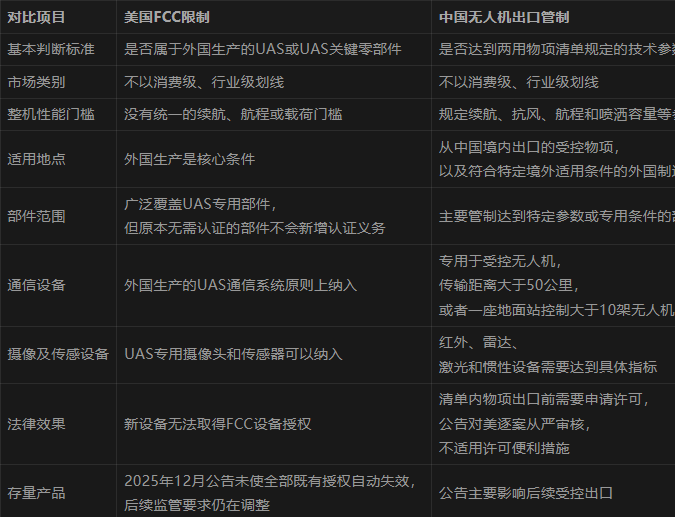
A standard consumer drone may not be on China’s control list but could be restricted by the FCC due to its foreign-made status. Conversely, a high-performance drone meeting China’s control parameters may be subject to both sets of measures.
Cross-referencing the two regimes reveals four distinct categories:
FCC Does Not Block / China’s List Includes: Controlled drones with existing FCC authorization, and listed components/technologies that do not require FCC authorization. Exports to the U.S. require case-by-case strict review.
FCC Does Not Block / China’s List Excludes: Unrestricted flow. Authorized standard consumer drones and unlisted ordinary components.
FCC Blocks / China’s List Includes: Double restriction. New models of controlled drones, and controlled communication/radar equipment requiring FCC authorization. Exports require Chinese licensing and face difficulty obtaining new FCC authorization.
FCC Blocks / China’s List Excludes: U.S. restriction only. New foreign-made models not on China’s list, typically new standard consumer drones. These products are generally not on China’s control list but cannot obtain new FCC authorization.
Note: “China’s List Excludes” in the table assumes normal civilian end-uses. If involving WMD proliferation, terrorism, military purposes, or other statutory security risks, China’s controls on non-listed items still apply.
The direct impact of Announcement No. 34 is concentrated in the top-left category. This includes controlled drones with existing FCC authorization, as well as listed components and technologies that do not require FCC authorization, such as high-power aviation engines, certain non-wireless special mission payloads, modification components, and related design, production, and usage technologies.
Since these items do not require FCC authorization, U.S. companies, professional users, and maintenance service providers may still seek to procure them from China. Following the implementation of Announcement No. 34, exports of these items to the U.S. are uniformly subject to case-by-case strict review, constituting the direct industrial impact of the announcement.
Why China’s Measures Remain Meaningful Despite U.S. Restrictions
The U.S. market still contains Chinese drones and professional equipment with existing authorization. Announcement No. 34 will not directly affect the export of non-listed standard consumer models for normal civilian end-uses, but it may impact controlled professional models, special payloads, high-performance components, and related technologies within the existing inventory.
The FCC equipment authorization regime does not cover all items in the drone supply chain. Aviation engines exceeding 16 kW, certain non-wireless mission payloads, modification components, and related technologies may be on China’s control list yet require no FCC authorization. U.S. restrictions on new Chinese drone models do not automatically sever procurement demand for these products and technologies.
As the U.S. pushes for domestic drone production, it still needs to fill gaps in propulsion systems, mission payloads, communication equipment, and manufacturing technologies. As long as U.S. manufacturers, maintenance providers, or professional users need to obtain listed items from China, they will face case-by-case strict review.
Notably, Announcement No. 34 also covers related technologies. While U.S. companies can switch complete drone suppliers, design parameters, production processes, system debugging capabilities, and scalable manufacturing expertise cannot be replenished in the short term. Strict review of controlled technologies may affect joint development, product adaptation, production line construction, and high-performance system integration.
Conclusion
The FCC restricts new models of foreign-made consumer, industrial, and agricultural UAS and their key components from entering the U.S. market. China, meanwhile, implements export controls on listed drones, key components, and related technologies based on parameters such as endurance, wind resistance, range, spraying capacity, and component performance, while constraining non-listed drones through end-user and end-use reviews. The products and industrial segments covered by these two regimes are not identical.
Based on public specifications, products such as the DJI Mavic 3 Pro, Air 3, Matrice 350 RTK, and Matrice 400 generally do not meet the complete conditions of 9A012.a, so the direct impact of Announcement No. 34 on standard consumer drone units is relatively limited. Large agricultural drones, long-endurance platforms, special mission payloads, high-performance components, and related technologies are more likely to fall within China’s export control scope.
China’s MOFCOM Announcement No. 34 specifically targets controlled drones, high-performance components, and related technologies that the U.S. may still obtain from China. Its scope includes both controlled products that can still enter the U.S. market and engines, certain mission payloads, modification components, and related technologies that do not require FCC authorization.
Therefore, this countermeasure is highly targeted and will have a tangible impact on relevant industrial segments. U.S. restrictions on new foreign drone models have not eliminated U.S. market demand for certain Chinese high-performance components, special payloads, and related technologies; Announcement No. 34 further tightens the channels for these items and technologies to reach the United States.