

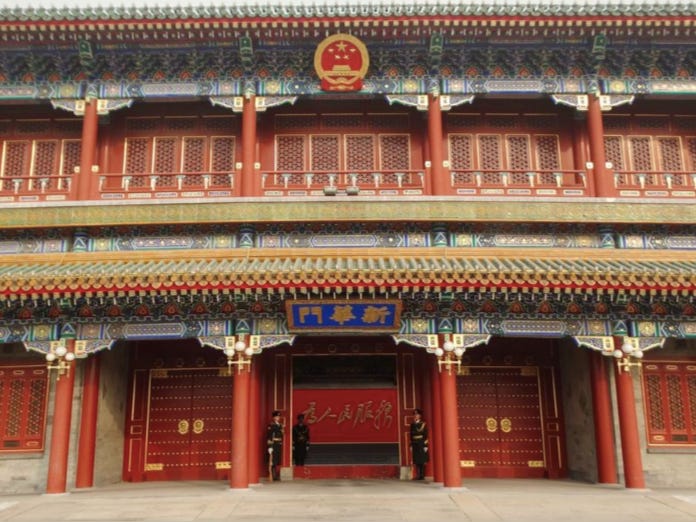
On July 30, the CPC Central Committee Political Bureau (政治局), the core decision-making and leadership body of the Communist Party of China (CPC), held a meeting to map out economic work for the second half of the year.
This is a key window for the world to gauge China’s economic policy, as upcoming financial, fiscal, industrial, and trade measures will be based on it. The last similar meeting was in late April, focusing on Q2.
China’s economic policies are highly consistent, generally following the framework set at last year’s Central Economic Work Conference (中央经济工作会议). As a result, the structure and wording of these readouts often share similarities.
However, shifting domestic and global economic conditions inevitably bring adjustments. Spotting these changes is key to understanding the policymakers’ evolving priorities. Below, I’ll compare the July and April readouts to help you see what’s different.
Macro policy
July Readout
……加快推动新旧动能转换,实施好更加积极的财政政策和适度宽松的货币政策,充分发挥各项存量政策效能,及时谋划出台务实管用的增量政策,加大逆周期调节力度,加力扩大内需、优化供给,切实保障和改善民生,增强发展动力、激发社会活力……
The meeting urged efforts to fully leverage the effectiveness of existing policies, promptly introduce practical and effective incremental policies, step up counter-cyclical adjustments. This was not mentioned in the April readout.
Existing policies are macroeconomic measures already implemented and continuing to provide stable support.
Incremental policies are newly introduced tools or institutional arrangements designed to address emerging issues or achieve specific goals, such as cutting interest rates or issuing ultra-long-term special government bonds. Some experts believe that "practical and effective incremental policies" primarily refer to targeted measures rather than indiscriminate stimulus.
Counter-cyclical adjustment refers to policy measures taken by the government or central bank against the current economic cycle to smooth out severe fluctuations and prevent drastic booms and busts. For example, during an economic downturn, authorities may adopt expansionary policies such as cutting interest rates, lowering reserve requirements, increasing public investment, or reducing taxes.
This readout mentions only counter-cyclical adjustment, rather than pairing it with cross-cyclical adjustment as before. The latter implies that policymakers look beyond the current cycle—avoiding excessive stimulus during good times while focusing on debt risk prevention and structural reforms. Some experts believe that highlighting counter-cyclical adjustment alone signals a stronger emphasis on stimulus policies to boost economic recovery.
April Readout
……推动科技自立自强、产业链自主可控,精准有效实施更加积极的财政政策和适度宽松的货币政策,持续扩大内需、优化供给,做优增量、盘活存量,着力稳就业、稳企业、稳市场、稳预期,增强经济发展内生动力……
Notably, phrases such as “technological self-reliance and self-strengthening, independent and controllable industrial chains,” and “stabilizing employment, enterprises, markets, and expectations” are absent from the July readout.
July Readout
宏观政策要发力提效,加快财政支出和债券资金使用进度,有力推进“两重”建设和“两新”工作。兜牢基层“三保”底线。综合运用并适时调整货币政策工具,优化实施财政金融协同促内需政策。
The meeting urged efforts to accelerate fiscal spending and bond fund utilization to vigorously advance initiatives for major national strategies and key-area security capacity building, as well as large-scale equipment renewals and consumer goods trade-ins.
The meeting urged efforts to comprehensively utilize and timely adjust monetary policy tools, and optimize coordinated fiscal-financial policies to boost domestic demand.
New large-scale infrastructure projects and consumption will receive more fiscal funding, rather than relying solely on monetary policy.
Also, whether "timely adjusting monetary policy tools" will lead to RRR (reserve requirement ratio) or even interest rate cuts remains to be seen.
April Readout
增强货币政策前瞻性灵活性针对性,保持流动性充裕。保持人民币汇率在合理均衡水平上的基本稳定。做好宏观政策取向一致性评估。
The July readout does not mention maintaining the basic stability of the RMB exchange rate at an adaptive and balanced level.
Industrial Policies
July Readout
加强对基础研究的长期稳定支持……积极推动前沿技术突破和未来产业发展,着力打造新兴支柱产业,持续推动传统产业改造升级……优化民营经济发展环境,推动平台经济规范健康发展。
The meeting urged efforts to strengthen long-term and stable support for basic research... actively promote breakthroughs in frontier technologies and the development of future industries, focus on cultivating new pillar industries, and continuously drive the transformation and upgrading of traditional industries... optimize the business environment for the private sector, and promote the standardized and healthy development of the platform economy.
Support for basic research, optimizing the business environment for the private sector, and regulating the platform economy were not mentioned in the April readout.
April Readout
会议强调,要加快建设现代化产业体系,保持制造业合理比重。纵深推进全国统一大市场建设,深入整治“内卷式”竞争。全面实施“人工智能+”行动,发展智能经济新形态,完善人工智能治理。进一步深化国资国企改革。系统应对外部冲击挑战,提高能源资源安全保障水平,以高质量发展的确定性应对各种不确定性。
The July readout does not mention systematically addressing external shocks and enhancing energy and resource security.
Financial policy
July Readout
会议强调,要切实筑牢安全屏障。稳定房地产市场,实施好一揽子化债方案,扎实推进地方中小金融机构改革化险、减量提质。深化资本市场投融资综合改革,提升资本市场韧性和信心。
The meeting urged efforts to deepen comprehensive reforms of the capital market's investment and financing system, and enhance its resilience and market confidence.
Investment and financing reform refers to leveraging the capital market's dual function of investment and financing, shifting away from the past emphasis on financing over investment, bolstering patient capital, supporting hard-tech enterprises and improving returns for investors.
Against the backdrop of a weak stock market, the introduction of the term “resilience'“ likely signals an intention to stabilize the market.
Trade policy
July Readout
会议指出,要拓展国际经贸互利合作空间,大力发展服务贸易,促进贸易平衡发展。完善对外投资管理制度和海外综合服务体系,积极吸引和利用外资。
The meeting urged expanding mutually beneficial international trade, vigorously developing trade in services, and promoting balanced trade. It also called for improving outbound investment management and overseas comprehensive services system, while actively attracting foreign investment.
The April readout did not mention international trade and investment.