
China's First Systematic Rebuttal to Overcapacity Claims: The Key Arguments
Overcapacity is ill-defined and a universal phenomenon. Crucially, it is not caused by industrial subsidies, trade surpluses, economic imbalances, or market competition.

China Speaks Up: On July 28, China’s Ministry of Commerce released a white paper on “overcapacity,” marking Beijing’s first systematic response to foreign accusations against the world’s top manufacturer.
As the world's largest manufacturing nation, China has seen claims of “overcapacity” widely circulated both globally and domestically. In its latest response, the Chinese government did not deny having massive capacity, but rather offered a different interpretation. Here are the core takeaways:
1. Core Stance
China views the “overcapacity” narrative and subsequent restrictions as protectionism that politicizes trade issues. It calls for a comprehensive, objective, and dialectical view of the issue.
2. Key Views on Global Capacity
China’s role as the “world’s factory” is a result of global division of labor.
Overcapacity is dynamic; supply-demand balance is relative, not absolute. There is no universal definition.
Benchmarks must be context-specific, accounting for development stages and industry differences.
3. Rebutting the Accusations
Subsidies: No direct link to overcapacity. Subsidies are a common global tool (e.g., US IRA, EU acts). China’s subsidies follow WTO rules, focus on R&D/green tech, and treat all firms equally.
Trade Surplus ≠ Overcapacity: Surpluses reflect savings-investment gaps, seen in many developed nations. China’s exports stem from competitiveness and global green demand, not a deliberate pursuit of surpluses.
Not Due to Weak Domestic Demand: Domestic demand drives 93% of China’s growth. Slower growth reflects high-quality development, not insufficiency. Global imbalances have complex structural roots.
Competition is Healthy: Market competition prevents无序 (disorderly) expansion. Opposes using “fair competition” as a guise for protectionism.
4. China’s Positive Industry Narrative
Innovation-Driven: Growth relies on high R&D input and tech breakthroughs (e.g., NEVs, AI), not just subsidies.
Reform: Supply-side reforms are reducing outdated capacity; industrial utilization is at a reasonable ~74.4%.
Global Contribution: Lowers costs for global green transition (solar/wind), eases inflation, and helps developing nations industrialize.
5. Call for Global Cooperation
Win-Win: Seize new tech revolutions (AI, bio-manufacturing) to grow the global pie.
Respect Market Rules: Oppose politicizing economics or “building walls.”
Policy Coordination: Major economies should communicate and resolve disputes within the WTO framework.
Expand Openness: Reduce trade/investment barriers and uphold multi-lateralism.
Bottom Line:
Capacity issues are normal in economic development. China advocates for market-based, global cooperation over confrontation to maintain stable supply chains and promote inclusive global growth.
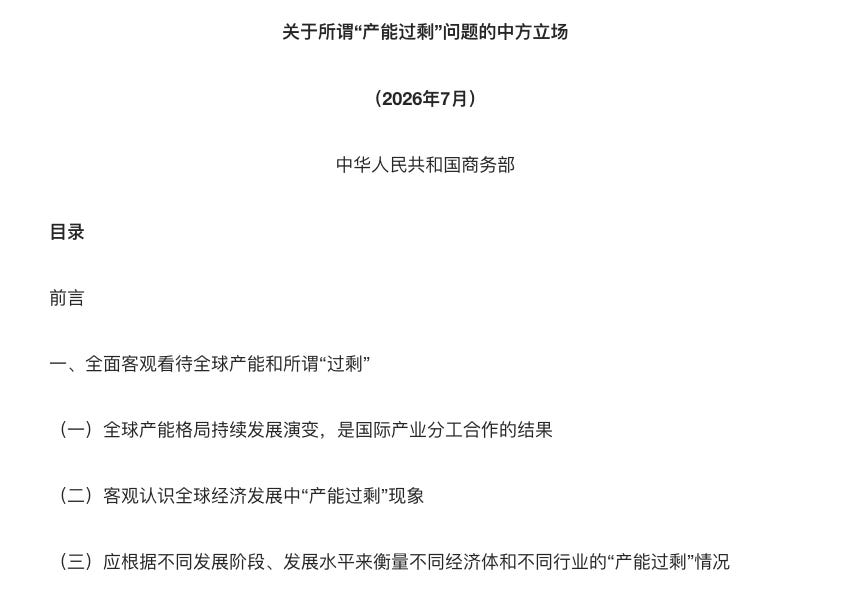
I've selected some excerpts from the full text. Please note that the English version isn't an official translation and is for reference only.
The document argues that overcapacity is a constantly changing phenomenon. Simply put, what is considered overcapacity today may not necessarily be so tomorrow.
“Overcapacity” is a dynamic phenomenon in a market economy. Under a market economy, the supply and demand of capacity are always in a dynamic cycle of “balance–imbalance–rebalancing”; a permanently balanced state of capacity does not exist. Whether overcapacity exists depends on the supply-demand relationship and is dynamically adjusted throughout the industry’s life cycle. Supply-demand balance is relative, while imbalance is universal…During technological transformations, emerging capacity creates new supply while existing capacity becomes redundant, leading to phased and structural supply-demand imbalances. Through market mechanism adjustments, the supply-demand landscape converges toward a new equilibrium.
The document argues that there is no clear definition of what actually constitutes overcapacity.
There has always been controversy over the issue of “overcapacity,” and no major international organization has provided an official definition. The World Trade Organization (WTO) agreements do not define “overcapacity” nor contain provisions specifically targeting it. The International Monetary Fund (IMF) considers “overcapacity” a complex concept that must be understood within specific macroeconomic contexts. Economists generally describe “overcapacity” from both macro and micro perspectives: macroscopically, it refers to a situation where an entire industry’s production capacity significantly exceeds the total effective market demand; microscopically, it describes a state where a firm’s actual output falls short of its optimal output due to monopolistic competition. In national economic practices, a state where production capacity exceeds effective demand is common due to economic cycle fluctuations. Different countries and industries vary greatly in their criteria and perspectives for judging overcapacity.
The document notes that capacity utilization in developing countries is lower than in developed ones, so a one-size-fits-all standard shouldn't be applied.
The capacity utilization rate is often used to measure “overcapacity,” but it must be viewed in the context of each country’s specific realities…Data from relevant institutions show that the median capacity utilization rate for developed and fast-growing economies mostly falls within the 75%–80% range, while that of underdeveloped countries generally ranges from 50% to 64%. This is because underdeveloped countries face constraints such as inadequate infrastructure and capital, preventing full capacity utilization.
Also, capacity utilization varies across different sectors; for example, it tends to be lower for low-value-added products.
Capacity utilization rates vary significantly across different industries. According to the latest data published by the 27 EU member states for 725 industries, 169 industries have a utilization rate below 70%.
Having clarified the understanding of overcapacity itself, the document then responds to the four common arguments used to accuse China of overcapacity.
Why industrial subsidies not linked to overcapacity?
Reasonable industrial subsidy policies help correct market failures, promote technological innovation, environmental protection, poverty reduction, and balanced development, and do not cause so-called “overcapacity.” Many countries adopt tailored industrial policies based on their national conditions and industrial development needs, such as providing R&D subsidies for emerging industries or risk subsidies for agriculture. These are also legitimate industrial and trade policy tools for WTO members.
Subsidies themselves are not the problem, but they should be used reasonably under WTO principles of openness, fairness, and compliance. Major countries… should take the lead in opposing subsidy abuse and discriminatory subsidy policies. The US Inflation Reduction Act plans to provide $750 billion in various subsidies from 2022 to 2031, with electric vehicles receiving subsidies required to meet conditions such as local or North American production and sales, effectively excluding other WTO members. US industrial subsidies in the field of artificial intelligence far exceed those of all other countries combined.
According to incomplete statistics, the European Commission will provide over €1.44 trillion in various subsidies between 2021 and 2030. The EU’s Industrial Accelerator Act directly links local content requirements to financial support through “Made in EU” requirements.
Having criticized the subsidies of the US and Europe as inequitable, the document states that China's subsidies meet the required standards.
Over the years, China has continuously standardized and improved relevant policies in terms of compliance, scientific rigor, and transparency. It has specifically cleaned up and regulated non-standard practices in some localities and established a unified negative list management mechanism for local financial subsidies.
The Chinese government has effectively and comprehensively fulfilled its transparency obligations; the latest notification on central and local government subsidy policies for 2023–2024, submitted in June 2025, achieves nationwide coverage. China’s subsidies apply equally to all types of market entities and primarily target technological R&D, industrialization breakthroughs, and market consumption.
Greater emphasis is placed on market-oriented and guiding indirect measures such as public services, technical standards, and skills training, with a focus on supporting technological R&D and innovation, SME development, and green energy conservation. For example, in the consumer goods trade-in program, the principle of equal treatment for domestic and foreign entities is upheld; subsidy policies for trading in old automobiles and home appliances, as well as purchasing new digital and smart products, treat all enterprises equally, with foreign-invested enterprises actively participating and benefiting equally.
Why trade surpluses not linked to overcapacity
The document states that a trade surplus does not equate to overcapacity.
From the history of global economic development, manufacturing powerhouses such as the UK, US, Japan, and Germany have all maintained surpluses for extended periods. It is also common for Germany and Japan to have current account surpluses exceeding 6% of their GDP. Emerging markets with rapid export growth, such as Indonesia and Mexico, have also become surplus countries, while Brazil and Vietnam have achieved trade surpluses for 10 consecutive years.
In terms of industry products, 80% of US chips are exported, and about two-thirds of Boeing’s commercial aircraft deliveries are sold to customers outside North America. In 2025, the EU’s trade surpluses in automobiles, pharmaceuticals, and cosmetics were $92.2 billion, $214.6 billion, and $11.6 billion, respectively. If a large surplus inevitably means overcapacity, should these export-heavy, surplus-generating industries and products also be deemed “overcapacity”?
China's export products in recent years have met new global demands.
China’s export growth stems not only from economies of scale and enhanced innovation capabilities but also from the global demand for green transition and industrialization. For instance, China’s export growth to Europe is mainly concentrated in photovoltaics, new energy vehicles (NEVs), lithium batteries, and chemical products, which largely reflects the demand for energy products driven by the green transition and the rising production costs of Europe’s chemical industry due to the energy crisis. China also never deliberately pursues a larger share of labor-intensive product exports; the proportion of such products in total exports dropped from 20.7% in 2012 to 15.1% in 2025.
Although we sell a lot, we also buy a great deal.
China’s import scale has ranked second globally for 17 consecutive years, making it a major export destination for nearly 80 countries. It has implemented zero-tariff policies for 63 countries and is the first major economy to achieve full zero-tariff coverage for all African countries with diplomatic ties and all least-developed countries with diplomatic ties. China is the only country to host an international import expo; having successfully held eight sessions, the cumulative intended transaction volume has exceeded $580 billion.
Why economic imbalances not linked to overcapacity?
China denies insufficient domestic demand which may leads to overcapacity.
China is not only a manufacturing powerhouse but also a major consumer market. Domestic demand has always been the main engine of China’s economic growth; from 2013 to 2024, domestic demand contributed an average of 93% to China’s economic growth, with consumption and investment contributing 55% and 38% on average, respectively. China’s total retail sales of consumer goods grew from 23.8 trillion yuan in 2013 to 50.1 trillion yuan in 2025, doubling in size. Converted at the World Bank’s purchasing power parity (PPP), China’s total retail sales in 2025 were equivalent to 1.7 times that of the US, making it the world’s largest consumer goods market in fact. Currently, China ranks first globally in physical consumption, and per capita annual consumption of some industrial products has approached the level of developed countries. In recent years, the slowdown in the growth rate of China’s total retail sales is consistent with the country’s transition from high-speed growth to high-quality development and reflects the upgrading of China’s consumption structure. Commodity consumption remains relatively stable, while service consumption is growing rapidly; per capita service consumption expenditure has grown at an average annual rate of 8.5% over the past five years. Viewing the slowdown in retail sales growth as insufficient domestic demand is neither objective nor comprehensive. The argument that “insufficient domestic demand in China leads to overcapacity” is even more a fallacy of equivocation, misapplying micro-level market phenomena to the macro-structural level.
Why the fierce market competition in China not linked to overcapacity?
Market competition itself is the most effective mechanism to prevent disorderly capacity expansion; otherwise, products will face sluggish sales, losses, and eventual elimination by the market. The role of the government should be to maintain competitive order and a fair environment, allow the market to play a greater role, and enable backward capacity to naturally exit through competition.
China believes it is wrong for those who intervene in the market to criticize those who encourage competition.
In recent years, some economies have placed their own interests above international rules, violated the principle of fair competition, and even used unfair means under the guise of fair competition to pursue protectionism. The US has implemented non-compliant tariff measures, adopted targeted investment restrictions, and abused export controls and sanctions, severely undermining fair competition. The EU has introduced a series of economic and trade legislation and measures, such as the Industrial Accelerator Act, which imposes restrictive requirements on foreign investment in four emerging strategic industries—batteries, electric vehicles, photovoltaics, and critical raw materials—constituting severe investment barriers. Accusing China of “unfair competition” and “non-market policy practices” is a typical case of double standards and is truly unfair.